Check two things about your lot first
Two facts about your lot decide which offices handle the job. Get both answers before you compare prices.
1. Is the house inside Town limits? The Town of Bernalillo, the Sandoval County seat, writes its permit instructions for work "within the Town limits". A Bernalillo mailing address does not settle that. Ask the Town's Planning and Zoning office (P&Z) to confirm your address or parcel number on the zoning map. If the lot is outside the limits, the Town route on this page does not apply; ask Sandoval County which office reviews it.
The county names cause a second mix-up. Bernalillo County is a different county: it holds Albuquerque, and the City of Albuquerque runs its own permit system (see the Albuquerque page). If a quote for a Town address names Albuquerque or Bernalillo County as the permit office, ask the installer why before you go further.
2. Is the lot in the Town's mapped floodplain? The Town checks floodplain status as part of its zoning review of a building permit application. If the lot is in a mapped flood zone, the job adds a Town Floodplain Development Permit and a value test on the work, both explained below. No town-wide count of floodplain lots was available for this page, so check your own: ask P&Z for your parcel's flood zone. If you have an elevation certificate (a surveyor's form recording the building's height against the expected flood level) from a purchase or a flood insurance policy, find it now, because P&Z may ask for it.
Town sign-off first, then the state CID permit
In Bernalillo, the Town does not issue your solar permit. The Construction Industries Division (CID), part of New Mexico's Regulation and Licensing Department, issues the building and electrical permits and does every inspection for the Town. The Town reviews the application first.
As the Town's Planning and Zoning page describes it, solar panels, stucco, re-roofs and demolition all need a CID building permit before work starts, and Town staff must sign off on the application before it goes to CID. The order:
- The contractor emails the CID application and plans to Town P&Z. A homeowner pulling their own permit uses the homeowner application.
- Town staff review zoning and floodplain. A floodplain lot adds the Floodplain Development Permit application.
- Review generally takes 2 to 3 days. The Town emails a review fee.
- After payment, the Town returns the signed application with a receipt.
- The contractor files with CID electronically through the state's online permitting portal.
- CID issues the permits and does the inspections. PNM, the utility, comes after the final CID inspection.
The Town's list puts stucco and re-roofs in the same permit sentence as solar panels. On a flat-roof house, a re-coat, re-roof or parapet stucco repair can therefore be a permitted scope of its own. Ask whether the quote's permit line covers that work or only the panels.
The state's construction permit rule, 14.5.2 NMAC, sets the electrical side. The electrical permit goes to a New Mexico electrical contractor holding an EE-98, EL-1 or ER-1 license. For a roof mount, the submittal to CID must include the calculated added loads. Ask to see that figure before you sign, because it is the same number that decides the engineer question further down.
Homes facing Camino del Pueblo: the MainStreet Overlay
If the house fronts South Camino del Pueblo between US 550 and Avenida Bernalillo, it is in the Town's MainStreet Overlay. The zoning ordinance treats exterior alterations there as a "substantial change in appearance" that needs a Commission-approved site development plan, decided within 30 days.
The ordinance does not say whether rooftop solar counts, so ask P&Z before you sign and add those 30 days to your timeline if the answer is yes. State law (NMSA 3-18-32), as EcoGen's state summary describes it, limits town restrictions on solar outside historic districts, but a review step can still apply. On a house like this, the proposed service would keep a low-tilt array below the parapet line so less of it shows from the street.
Floodplain lots: the $65 permit and the 50% test
If your lot is in the floodplain, read the Town's Floodplain Development Permit form (updated August 2021) before you choose a quote. The fee is $65. The form asks for two numbers:
- the value of the improvement, at fair market value: what the work is worth;
- the pre-improvement value of the structure: what the house itself is worth now, without the land.
It then sorts the job into one of two boxes. Minimum improvement is work worth less than 50% of the structure's value. Substantial improvement is work worth more than 50%. The box matters. The form's elevation-certificate condition is written around new or substantially improved buildings, and the form states that no building permit will be issued until the floodplain permit and the elevation certificate are complete.
Flat-roof solar quotes often arrive with a re-coat or parapet repair attached. That is work on the house too. Add the roof work and the solar together, then divide by the structure value. The example below lands far under 50%, but run your own numbers, especially if the structure value is low or other work on the house is planned.
Three questions the form does not answer. Take them to P&Z:
- Is an elevation certificate required for rooftop solar on an existing house in the minimum-improvement box?
- Does the Town count earlier work on the house toward the 50% line?
- Who may prepare the floodplain application: homeowner, contractor, or either?
Then have each installer write both values on the quote, name who files the floodplain permit, and say whether the $65 fee is included. A quote that skips this step on a floodplain lot has skipped the step that holds up the CID permit.
Read the flat roof before the panels
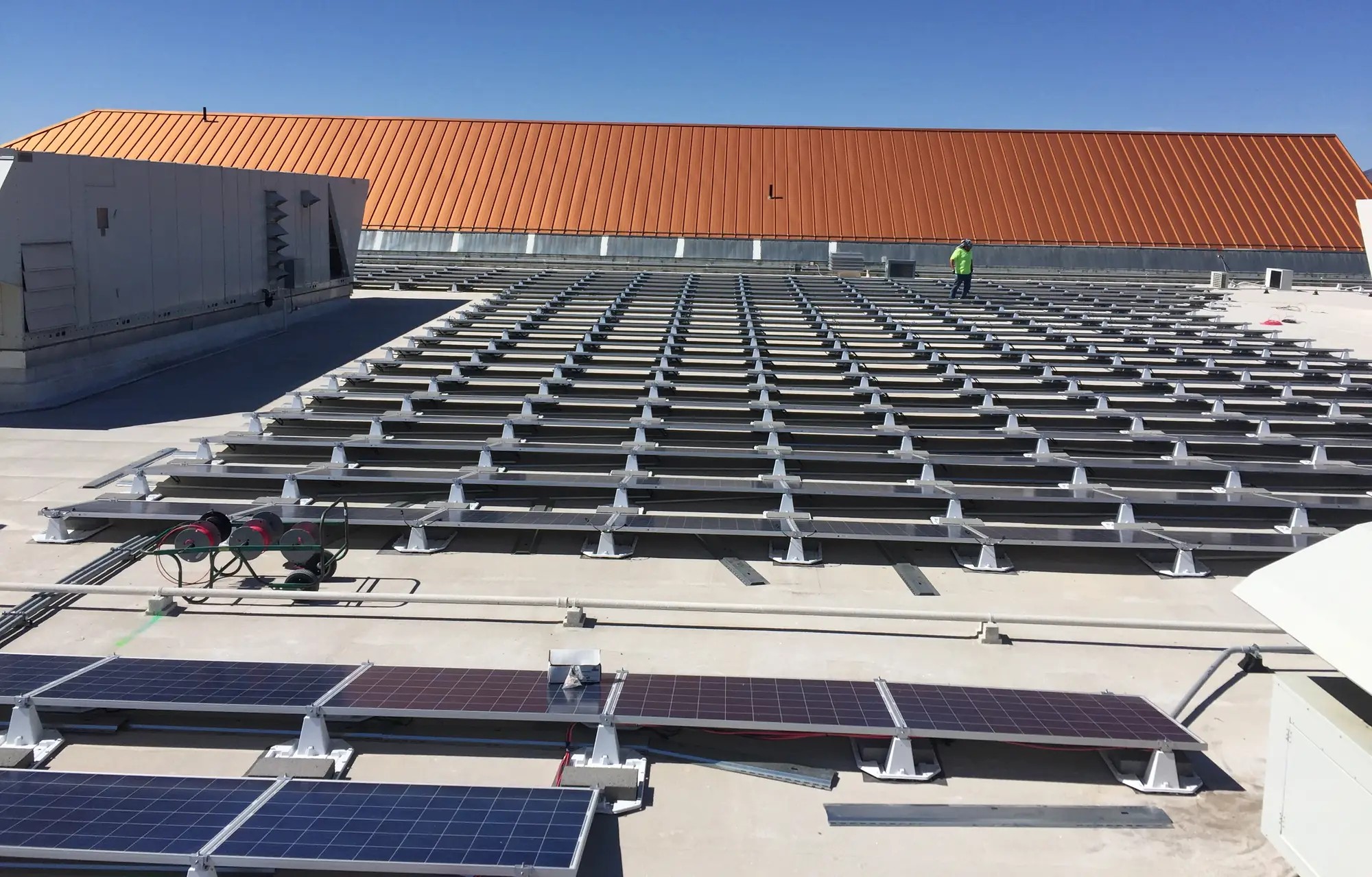
On a flat roof, water moves slowly, parapets hold it in, and the array sits in its path. The roof's condition decides the mount, the drainage layout and which repairs must come first, so read it before anyone prices panels.
A few terms first. A parapet is the low wall, usually stucco, that rises above the roof edge. A canale is a channel that carries water out through the parapet; a scupper is an opening in the parapet that does the same job. The roof covering is the waterproof layer: built-up (tar and gravel), modified bitumen (asphalt sheets), TPO (a single-ply plastic membrane) or an elastomeric coating painted over an older surface.
Check these first:
- Coverings. Each coat laid over an older one adds weight and may affect what the coating or membrane maker's warranty allows. Count them, and ask what the warranty says about mounting on top.
- Last re-coat. An aging coating will need redoing within the array's life, and panels in the way make that harder and costlier.
- Ponding. Dried rings show where water sits after a storm. Keep rows and ballast off them.
- Slope to drains. Every canale and scupper needs a clear path of water to it, and someone needs to be able to reach it to clear it.
- Parapet caps and stucco. Cracks let water into the wall, and the wiring often has to cross it.
- Rooftop equipment. Evaporative coolers, HVAC units and skylights take space, cast shade and need service access.
What a roof finding changes in Bernalillo
Say the survey finds the coating worn out and a cracked parapet cap. In Bernalillo that one finding touches three separate rules:
- Permit. The Town lists stucco and re-roofs alongside solar as work needing a CID building permit, so the repair may need its own permit, filed through the same Town-then-CID route.
- Floodplain. On a floodplain lot, the repair's value goes into the improvement total on the Town form.
- State credit. New Mexico's solar tax credit excludes roof repair (see the credit section), so the repair earns nothing toward it.
That is why roof work belongs on its own quote line, with its own permit answer. Also ask what removing and reinstalling the array at the next re-coat will cost. If the installer will not price it, get that in writing as "not included" rather than leaving the question open.
Ballast or attached: the 5 lb/sq ft line
On a flat roof, the mount method sets part of the paperwork and part of the price. A ballasted array sits on racking held down by concrete blocks, with few or no holes in the roof. An attached array is bolted through the covering into the framing, each attachment flashed (sealed) into the membrane.
Two load terms decide it. Dead load is the permanent weight the array adds, spread over its footprint, in pounds per square foot (lb/sq ft). Point load is weight landing on a single spot.
Under section 14.5.2.8 F of the same CID rule, a New Mexico-licensed engineer must analyze the roof when an array adds more than 5 lb/sq ft of dead load, puts more than 45 lb on one point, puts more than 200 lb on a single truss, rafter or joist, uses a unique mount design, or sits on over-spanned framing. If the roof needs reinforcement, that adds a general building permit.
| Ballasted | Attached | |
|---|---|---|
| Added weight | Higher; ballast blocks can push the array past 5 lb/sq ft | Lower; no ballast blocks |
| Roof penetrations | Few or none | One per attachment, each flashed into the membrane |
| Engineer review | Required once added dead load passes 5 lb/sq ft | Required if the 45 lb point or 200 lb member limit is crossed |
| Drainage risk | Blocks and trays can sit in water paths | Rails can sit above the flow path |
| Bernalillo paperwork | Added-load figure to CID, plus the engineer letter if over 5 | Mounting-system listing and added-load figure to CID |
A promise never to penetrate a flat roof tells you the array is ballasted. It tells you nothing about its weight. Ask for the racking report's lb/sq ft and point loads, and for an engineer letter line on the quote if the figure crosses 5. Then check that the load on your quote is the load going to CID. On a floodplain lot, any reinforcement is more work on the structure, so add it to the improvement value too.
Manufactured homes with low-slope roofs
On a manufactured home, the roof mount goes through a different state office. The Manufactured Housing Division's roof-mounted solar guide says to settle local zoning and floodplain first. In Bernalillo that is the same Town P&Z step, and the Town's page notes that a Floodplain Development Permit may also be required for manufactured homes. The mount is then permitted through the Division. Plans need the manufacturer's approved design pages (DAPIA pages) or a New Mexico engineer's letter, and must show penetrations, weatherproofing and loads. The Division does not inspect the wiring, and only Division-licensed contractors may do the mount.
One quote, four tests: an illustrative example
Here is how the checks work on one bundled quote for a Bernalillo floodplain lot.
Illustrative example. A house inside Town limits has a built-up flat roof behind parapets, and P&Z confirms the lot is in a mapped flood zone. The quote: 16 panels at 400 watts (6.4 kW DC) on a ballasted rack. Lines: solar equipment and labor $17,600; elastomeric re-coat and parapet-cap repair $2,400; engineer letter $650; Town Floodplain Development Permit $65. Total $20,715.
1. Floodplain test (Illustrative calculation). Improvement: $2,400 + $17,600 = $20,000. Against a $160,000 pre-improvement structure value, that is 12.5%, the "minimum improvement" box. The 50% line would be $80,000 of work.
2. Load test (Illustrative calculation). Panels 720 lb + rack 130 lb + ballast 1,400 lb = 2,250 lb over about 340 sq ft = 6.6 lb/sq ft. Over the 5 lb/sq ft line, so an engineer must analyze the roof. An attached rack at about 850 lb is 2.5 lb/sq ft, under the line, but adds flashed penetrations.
3. Price test (Illustrative calculation). Whole quote: $20,715 ÷ 6,400 W = $3.24/W. Solar only: $17,600 ÷ 6,400 W = $2.75/W. State benchmark: $2.71/W (EcoGen Solar Cost Index, September 2026 Edition, modeled installed price before incentives). The solar line is 4 cents a watt above it.
4. Credit test (Illustrative calculation). The re-coat is roof repair, which the state credit excludes. Ten percent of the $17,600 solar line is about $1,760. EMNRD decides each line; whether it accepts the engineer letter is not stated. No federal credit applies to an owned system placed in service after 2025.
Assumptions: all prices, weights, footprints and values are invented. A real check uses the assessor's or an appraiser's structure value, the racking maker's weights and the Town's floodplain decision.
How to use it: run the four tests on every quote you collect. A load over 5 lb/sq ft with no engineer line means the quote is incomplete. Take the roof work, engineer letter and fees out before dividing by watts. In this example the whole $20,715 gives $3.24/W, which would put a fairly priced solar line 53 cents above the state benchmark instead of 4.
For sizing, EcoGen's state model gives about 1,824 kWh per kW a year, so 6.4 kW is roughly 11,670 kWh (Illustrative calculation). That model does not cover a low flat-roof tilt, so ask for each installer's own production estimate and the tilt it assumes.
PNM and the credits that still apply in 2026
PNM (Public Service Company of New Mexico) serves the Town; its Rules and Regulations (March 2025) list the Town of Bernalillo in its Albuquerque Metro Division. Check the name on your bill anyway.
Two ratings matter here. kW-DC is the panels' combined rating; kW-AC is the inverter's output rating, often lower. PNM's program uses the AC figure.
According to PNM's net-metering terms (archived October 2026), a system with an inverter of 10 kW-AC or less banks surplus as kWh credits. In a kWh credit bank, a kilowatt-hour you send to the grid in a sunny month offsets one you would otherwise buy later. PNM says the credits never expire and pays leftovers at its energy rate when the account closes. Above 10 kW-AC, surplus is paid monthly at PNM's Rate 12, so ask for the AC rating on every quote.
Under the state's interconnection rule, 17.9.568 NMAC, the application fee is $150 for systems up to 25 kW, and permission to operate is normally due within 10 business days after the utility has the final electrical inspection clearance. In Bernalillo that clearance comes from CID, not the Town.
The state credit. New Mexico's solar credit is 10% of equipment, materials and labor, up to $6,000 per system, with a $30 million yearly statewide cap. EMNRD's guide to the New Solar Market Development Tax Credit lists costs for modification or roof repair to hold solar panels as disallowed, and a power-purchase agreement (PPA) is not eligible. The guide ties the fund year to the date the building inspection passes, and applications are due within one calendar year after the install year.
The application needs your inspection report. As EcoGen's New Mexico incentives guide puts it, the report must show the building authority, the permit number and the date the system passed. In Bernalillo that authority is CID, so you need CID's final inspection record, not a Town document. Ask who downloads it and who files the credit.
The federal credit is gone for owned systems. The IRS says the Residential Clean Energy Credit is not available for property placed in service after December 31, 2025. A 2026 quote that subtracts 30% for it is wrong.
Is solar worth it in New Mexico? That depends on your solar-only price, your PNM usage and your roof. Strong sun, banked kWh credits and the state credit help. The lost federal credit and any roof work needed first count against it.
What the proposed service would put in writing
Proposed service. Lobo Solar is a proposed solar design-and-install service for flat and low-slope roofs in the Rio Rancho area. Coverage of Bernalillo is proposed and not yet confirmed. For a Bernalillo house, it would hand over six documents before any price is final:
- Roof condition report with photos: coverings counted, last re-coat, ponding, parapet caps and stucco, and repairs needed first, with those needing their own CID permit marked.
- Mount-method decision sheet: ballasted against attached, with lb/sq ft, point loads, penetrations and sealing, the roof maker's terms, and whether the 5 lb/sq ft engineer line is crossed. The homepage explains how the sheet is built.
- Drainage plan: where water runs to each canale, scupper and drain, and how rows stay clear and drains stay reachable.
- Parapet and stucco detail: how conduit crosses the parapet or wall, how it is sealed, and who repairs the stucco.
- Solar-only price and $/W on its own line. Re-coat, roof repair, engineer letter, floodplain fee and any panel upgrade sit on separate lines, so the solar figure can be checked against the state benchmark, the floodplain improvement value can be added up, and the credit is claimed only on eligible costs.
- Responsibility sheet: who emails Town P&Z, who prepares any floodplain permit, who files with CID and books inspections, who applies to PNM, who downloads the CID inspection report for the EMNRD credit, and who handles the gross receipts tax deduction form (RPD-41341).
Optional, priced separately: roof repair first, an engineer's stamp, a panel upgrade, a battery, and a removal-and-reinstall quote.
What to have ready for the assessment. Twelve months of PNM bills, checked as actual meter reads rather than estimates; the date and type of the last re-coat or re-roof, and any permit for it; your parcel's flood zone and any elevation certificate; and HOA rules if the house has them.
Questions to ask before you sign in Bernalillo
Use this list with every installer, alongside the quote checklist on this site.
Lot and route
- Is the house confirmed inside Town limits?
- Is the lot in a mapped flood zone? Who prepares the floodplain permit, and is the $65 fee included?
- What improvement value and structure value did you use for the 50% test, and does the improvement include the roof work?
- Have you asked P&Z whether an elevation certificate is needed?
- If the house fronts South Camino del Pueblo, have you asked P&Z about the MainStreet Overlay?
- Who emails the Town, who files with CID, and does the permit cover the roof work?
- Which electrical license (EE-98, EL-1 or ER-1) is the permit issued under, and whose name is on it?
Roof and mount
- How many coverings are on the roof, and when was the last re-coat?
- Ballasted or attached, and why for this roof?
- What is the added dead load and the largest point load? If over 5 lb/sq ft, where is the engineer letter?
- Does the roof maker's warranty allow this mount on this covering?
- Where do rows sit relative to each canale, scupper and drain, and how is the parapet crossed?
- What does removing and reinstalling the array at the next re-coat cost?
Price, utility and credits
- What is the solar-only price per watt, with every roof line removed?
- What is the inverter's AC rating, and is it at or under 10 kW-AC?
- What production estimate did you use, for what tilt, and were the 12 bills actual meter reads?
- Who downloads the CID final inspection record and files the EMNRD credit, and by when?
Red flags
- Surplus credited at an "avoided cost" rate. PNM banks kWh for systems at or under 10 kW-AC.
- A 30% federal credit on a solar or battery system you would own and place in service in 2026.
- A PPA pitch that counts the state credit in your favor; EMNRD says a PPA is not eligible. On a lease, ask in writing who would claim what.
- Solar for All installations promised for 2026. EcoGen's state summary reports the program paused since August 2025.
- A timeline that skips the Town review, or names Albuquerque or Bernalillo County as the permit office for a Town address.