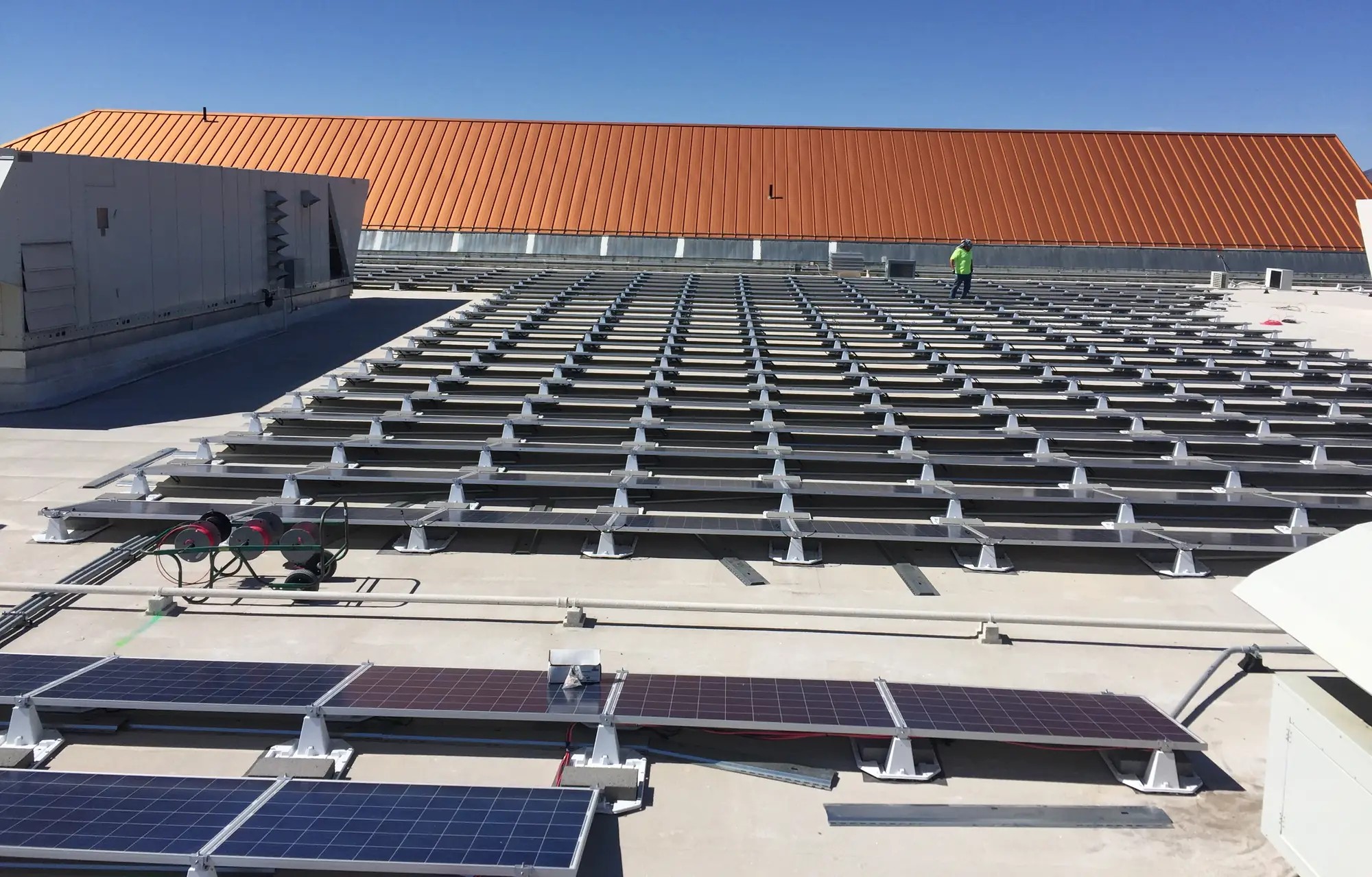
Count your roof coverings before you compare quotes
First, find out how many roofs your roof has. A roof covering is one complete weatherproof layer: a built-up tar-and-gravel roof, a modified bitumen roll roof, or a single-ply membrane such as TPO. A flat roof that was re-covered without the old layer coming off already has two. Elastomeric coatings rolled over an older surface are the open question, covered below.
The City of Albuquerque's roof-mounted solar checklist asks the installer to state the "roofing type and the number of roof coverings" on the permit plans. For a home, it requires a sealed review by a New Mexico structural engineer when any of these is true:
- The roof has more than one existing roof covering.
- A ballasted array adds more than 5 lb/sq ft of dead load.
- Any single attachment point carries more than 45 lb.
- More than 200 lb lands on any one truss, rafter or joist.
- The mount is a unique design not listed for the installation.
- Framing members are already over-spanned.
A sealed structural review is a calculation stamped by a licensed engineer showing the framing can carry the added weight. It adds a cost and a document to the permit file.
Two cautions. The city's solar resources page still links a 2012 version of the checklist, while a 2020 revision sits elsewhere on cabq.gov. Both name the covering count and the 5 lb/sq ft line, so ask which one the installer files against. And neither version says whether a liquid-applied coating counts as its own covering. List every layer and coating you know about, with dates, and ask the installer to write down the count they will put on the plans.
Then use the count. With one covering, you have a real choice between ballasted and attached mounts. With two or more, every keep-the-roof quote should include the engineer review. A keep-the-roof quote with no engineer line on a layered roof is missing a cost.
These are the city's rules. If your address turns out to be in unincorporated Bernalillo County, the county's packet applies instead, and it is stricter about ballast (see the permit-office section below).
Ballast or attached: get the weight in writing
A ballasted mount holds panels down with concrete blocks resting on the roof. Nothing pierces the membrane, but the blocks are heavy. Their weight spread across the footprint is the dead load, in pounds per square foot (lb/sq ft).
An attached mount bolts feet through the roof into the framing. The array is lighter, but each foot puts a point load on one spot, and each foot is a penetration that must be flashed into the membrane: sealed with a boot, pitch pocket or membrane patch so water cannot follow the bolt inside.
In Albuquerque this is a paperwork choice as much as an engineering one. The city checklist asks for "point connections for standard installation or block layout for ballast systems", and for how each penetration is weatherproofed. So the information exists before the permit is filed. Ask for it before you sign.
Ask for a mount-method sheet that shows:
- Added dead load in lb/sq ft, racking and ballast included.
- The largest point load and the heaviest load on one member, in pounds.
- The ballast block layout, or the attachment layout with the number of penetrations.
- How each penetration is flashed into your specific covering.
- What your roof warranty, if you have one, says about penetrations or added weight.
- Which of the six engineer triggers applies, and why.
Hold every quote to that sheet. Without an lb/sq ft figure, a ballasted quote cannot be checked against the 5 lb/sq ft line, and you cannot tell whether its price already includes the engineer.
Worked example: ballast or tear-off on a two-layer roof
Every figure below is illustrative: not a quote, not a load calculation for your house, and not any installer's price.
Illustrative example · weight budget. Twenty 440 W panels make an 8.8 kW DC array (20 × 440 W = 8,800 W). At about 45 lb each, the panels weigh 900 lb and cover about 450 sq ft.
- Ballasted: 900 lb panels + 190 lb racking + 2,000 lb ballast = 3,090 lb ÷ 450 sq ft ≈ 6.9 lb/sq ft, over the checklist's 5 lb/sq ft line.
- Attached: 900 lb panels + 300 lb rails and feet = 1,200 lb ÷ 450 sq ft ≈ 2.7 lb/sq ft. Fifty feet carry about 24 lb each, under the 45 lb line, but that is 50 penetrations to flash.
Real weights come from the racking maker's site-specific layout.
Now price both on one house with a modified bitumen roof laid over the original built-up roof: two coverings.
| Illustrative calculation | Quote A: keep the roof, ballast | Quote B: tear off, new membrane, attach |
|---|---|---|
| Total on the proposal | $26,900 | $34,800 |
| Roof work inside the total | $1,600 re-coat and patch at the parapet | $9,800 tear-off and new single-ply roof, own re-roof permit, no truss repairs |
| Engineer review inside the total | $1,100 (two triggers: two coverings, 6.9 lb/sq ft) | None expected on these figures (one covering, 2.7 lb/sq ft, 24 lb per point); per-member load still to confirm |
| Solar-only cost | $24,200 | $25,000 |
| Solar-only $/W (÷ 8,800 W) | $2.75/W | $2.84/W |
| Gap to the $2.71/W state benchmark | 4¢ over | 13¢ over |
| Whole-bid $/W (misleading) | $3.06/W | $3.95/W |
| State credit, 10% of solar-only cost | about $2,420 | about $2,500 |
State benchmark: EcoGen's New Mexico solar cost index puts the state at $2.71/W in its September 2026 Edition. That is a modeled installed price before incentives, not a quote, so a few cents either side is normal and a large gap is a question to ask.
Split the roof out first. $/W here means the solar-only price divided by the array's DC watts, the panel nameplate total. Over the whole bid, Quote B looks almost a dollar per watt dearer. With the roof and engineer lines removed, the solar work is 9¢/W apart.
The state credit ignores the roof, too. Its guide excludes roof repair to hold panels, so neither the re-coat nor the re-roof earns credit. It does not say whether an engineer fee counts, so this example leaves it out. EMNRD makes the final call.
So the real trade-off is the roof you keep. Quote A is $7,900 cheaper today. It also keeps two coverings under a ballasted array, needs the engineer letter, and may not qualify for the city's same-day Express permit (not confirmed either way). When those layers wear out, the array comes off and goes back on. Quote B costs more now, clears both engineer triggers on paper, and puts a new membrane under the panels. Compare the roof each quote leaves you with, not the headline totals.
Design around drains, parapets, canales and the cooler
A flat roof slopes gently toward drains or toward the parapet, the short wall above the roof edge. Water leaves through canales (open channels through the parapet) or scuppers (openings in the parapet that feed a downspout). An array that blocks those paths turns a dry roof into a pond.
The city checklist asks for a site plan showing the array, disconnects, signage and "required access pathways", plus views of rooftop objects: equipment, vents, skylights and hatches. A rooftop evaporative cooler is rooftop equipment, so it belongs on that plan too. Ask each installer to mark:
- Where water runs to each drain, canale or scupper, and how rows stay clear of it.
- How rails or ballast trays sit above the flow path, and how someone reaches the drains to clean them.
- Service clearance around the cooler or HVAC unit, and the shade it throws.
- How conduit crosses the parapet or comes down a stucco wall, the flashing or sealant used, and who repairs the stucco.
Fire access needs its own question. National code language relaxes some pathway rules on very low-slope roofs, but how Albuquerque applies it to homes is unconfirmed. Assume no exemption and ask to see the pathways drawn on the plan.
Then price the next re-roof. PNM's solar guidance notes that a typical roof lasts about 20 years and tells buyers to price panel removal and reinstall. On a ballasted array, that means moving every block as well as every panel.
Which office permits your Albuquerque address
An Albuquerque mailing address does not prove a home is inside city limits. Parts of the area are unincorporated Bernalillo County, and the Village of Los Ranchos de Albuquerque is its own town, with its own rules.
The county publishes its own Bernalillo County solar permit packet, dated February 2024. Its rules overlap the city's but are not identical:
| Question | City of Albuquerque | Unincorporated Bernalillo County |
|---|---|---|
| Who issues the permit | Building Safety Division, filed in ABQ-PLAN | Planning & Development Services |
| Roof layers | Engineer review if more than one covering | Engineering waived only with one roofing layer |
| Weight lines | 5 lb/sq ft (ballasted), 45 lb per point, 200 lb per member | Same lines, plus typical framing (2x4 minimum, 24 in. on center or closer) |
| Mount | Ballast block layout or point connections on the plans | Waiver only if panels attach to framing, or to rails fixed to framing at 4 ft on center or closer, 18 in. or less above the roof |
| Spacing | Access pathways and rooftop objects on the site plan | 3 ft clearance around the array; no array more than 10 ft above the roof |
A ballasted array is not attached to framing, so on the packet's wording a ballasted county job looks like it needs engineering even on a single-layer roof. That is our reading of the packet; confirm it with the county before you rely on it.
If your home is in the Village, its zone review comes first and has its own paperwork; see the Los Ranchos de Albuquerque solar page.
Ask each installer to name the issuing office on the quote, and check the permit card once it is issued. If two installers name different offices for the same address, resolve that before comparing anything else, because the engineer rules differ.
How the city permit moves: ABQ-PLAN, Express and inspections
The city's solar page says a rooftop system needs a building permit and an electrical permit, and the electrical permit must be pulled by a contractor. Both go through ABQ-PLAN, the city's online permitting system. The page also commits to processing small rooftop solar permits in less than 3 business days, with inspection appointment times instead of windows.
Since October 2025 the city's Express Permitting System has covered "roof-mounted solar permits under 50 kWs" and "residential re-roof without any truss repairs", with same-day approval for projects that do not need extensive plan review. All required inspections still happen, booked in ABQ-PLAN. In October 2025 the city reported that 98% of inspections were completed within one business day.
What the Express pages do not say is whether a job needing a sealed structural review still qualifies. That covers the layered roofs and heavy ballasted arrays this page is about, so nobody should promise you a same-day permit for one. Ask which route the installer expects, and why. A tear-off has one quiet advantage here: a re-roof without truss repairs is itself an Express permit type.
The city sequence, with each step's published timing
| Step | Who acts | What the city, PNM or state rule says about timing |
|---|---|---|
| 1. Historic approval, only in an HPO zone (below) | Owner or installer, filed in ABQ-PLAN | Minor review: staff, no longer than 10 working days. Major review: Landmarks Commission hearing |
| 2. Re-roof permit, roof work and inspection, only if you tear off | Roofer | Re-roof without truss repairs: Express, same-day approval |
| 3. Solar building and electrical permits | Installer; electrical by a contractor | Under 3 business days for small rooftop PV; same-day if Express applies; engineer-triggered jobs unconfirmed |
| 4. PNM interconnection application | You sign it; installer prepares it | PNM's process gives a project nine months after it passes technical screening to finish |
| 5. Mounts, array and wiring installed | Installer | No published time; ask for the schedule in writing |
| 6. City inspections | Booked in ABQ-PLAN | Appointment times; 98% within one business day (city figure, October 2025) |
| 7. Photo of the approved permit tag sent to PNM | Installer | — |
| 8. PNM inspection, meter change if needed, permission to operate | PNM | Normally within 10 business days after PNM receives final electrical clearance (state rule) |
| 9. State credit application | You, with the inspection report | By December 31 of the year after the install year |
Permission to operate is PNM's written go-ahead to switch the system on. None of these published times adds up to a fixed three-month wait. When a quote gives a long timeline, ask which step it is waiting on: an HPO hearing, an engineer review, the roof work or the installer's own schedule.
Historic zones: Certificate of Appropriateness first
Albuquerque has seven Historic Protection Overlay (HPO) zones: East Downtown, East End Addition, Eighth and Forrester, Fourth Ward, Huning Highland and EDo, Old Town, and Silver Hill. The city's HPO zone rules require a Certificate of Appropriateness, the city's written approval of an exterior change, for "all exterior alterations, including porches, roofs, and windows". The solar checklist says this approval must accompany the building permit application.
The city describes Minor review, the 10-working-day staff decision, for work that does not need a building permit. A solar array does need one, so do not assume the quick route. Major review goes to a Landmarks Commission public hearing for major changes to Contributing or Significant buildings. A pre-application consultation sets the level, and the city does not say in advance which level a rooftop array gets. Book it before you finalize a layout.
According to EcoGen's summary of state law (NMSA 3-18-32), New Mexico cities may restrict solar collectors only in historic districts. So in an HPO zone, ask how visible the array will be from the street. Behind a parapet, a lower tilt can keep panels below the parapet line; ask the installer what that costs in yearly production, because this page does not model it.
What PNM credits and what the state credit leaves out
Inside city limits your utility is PNM. The city's solar page points residents to PNM, and the Public Regulation Commission's PNM listing includes Albuquerque in its service area.
How surplus is credited. According to PNM's net-metering terms as published in October 2026, a system whose inverter is rated 10 kW-AC or less is in the Small PV program. kW-AC is the inverter's output rating, usually lower than the panels' DC total. Small PV surplus is banked as kWh credits that never expire, with any balance paid at Rate 12 when the account closes. Above 10 kW-AC, surplus is paid monthly at Rate 12. The 8.8 kW DC example would normally sit under the line, but check the AC rating on the quote.
For the paperwork, the state interconnection rule (17.9.568 NMAC) sets a $150 application fee for systems up to 25 kW and the 10-business-day permission-to-operate timing in the table above. PNM says the homeowner must sign the application; the contractor cannot sign for you. PNM also warns never to sign a power of attorney with a solar company.
There is no federal credit to subtract. The IRS says the Residential Clean Energy Credit is not available for property placed in service after December 31, 2025.
The state credit excludes the roof. New Mexico's New Solar Market Development Tax Credit pays 10% of eligible cost, up to $6,000 per system, under a $30 million statewide yearly cap. The EMNRD credit guide disallows "costs for modification or roof repair to hold solar panels" and the cost of structural and surface-protection work the building would need anyway. You apply electronically with the inspection report showing the permit number and date. A power-purchase agreement is not eligible.
The city inspection date also sets the credit year. EMNRD assigns each application to a fund year by the date the building inspection passes, and applications that arrive after a year's $30 million is used are returned. In Albuquerque, that date is the city inspection booked in ABQ-PLAN. A job that passes in late December and one that passes in early January land in different fund years. Ask which year your inspection is likely to fall in, and apply once you have the report rather than waiting for the deadline.
Per the New Mexico Taxation and Revenue Department, the seller can deduct its receipts from selling and installing the system from gross receipts tax when you sign Form RPD-41341. Ask whether the quote's total already assumes you will sign it.
Three claims still turn up in Albuquerque solar marketing and guides, and each is wrong for a PNM customer buying in 2026. A PNM system at or under 10 kW-AC banks kWh credits; it is not paid an "avoided cost" rate. No 30% federal credit applies. And the process is not simply "about three months, and the installer handles it": you sign the PNM application yourself and file the state credit yourself.
The proposed Lobo Solar service for Albuquerque
Proposed service. Lobo Solar is a proposed solar design-and-install service for flat and low-slope roofs. Coverage of Albuquerque is proposed and not yet confirmed. Built around the city's checklist, the proposed service would deliver:
- Roof condition report: every covering and coating counted, remaining roof life, and repairs needed first.
- Mount-method decision sheet: the full weight sheet described above, plus roof-warranty terms and which engineer trigger, if any, applies.
- Drainage plan and parapet detail: the water path, drain cleaning access, conduit route and stucco repair.
- Solar-only price and $/W, with roof, engineer and panel-upgrade lines kept separate so the credit math works.
- Responsibility sheet: issuing office (city, county or village), HPO approval, permits, PNM application, permit-tag photo, EMNRD inspection report, Form RPD-41341, and who files each.
The proposed on-site assessment would take about two hours (illustrative duration). Bring 12 months of PNM bills, any roof warranty or re-roof permit, the age of each roof layer if you know it, and any HOA rules. The Lobo Solar homepage sets out the full proposed service.
Albuquerque quote checklist and red flags
Hand this list to every installer, and use the quote checklist on this site to compare answers.
- Issuing office: City of Albuquerque (ABQ-PLAN), Bernalillo County or the Village of Los Ranchos, named on the quote.
- Historic zone: if the home is in an HPO zone, when is the pre-application consultation, and how visible is the array from the street?
- Covering count: how many coverings, including coatings, and does that trigger the engineer review?
- Loads in writing: lb/sq ft, largest point load, heaviest load per member, and the ballast or attachment layout.
- Tear-off or keep: if tear-off, is it a re-roof without truss repairs, on its own permit and price line?
- Permit route: Express or standard review, and why? Who books the inspections?
- Drainage and parapet: water path, drain access, conduit route, stucco repair.
- Solar-only $/W: compared with the $2.71/W state benchmark, roof and engineer lines separate.
- Inverter rating: at or under 10 kW-AC for PNM's Small PV kWh bank.
- Who files what: PNM application (you sign it), permit-tag photo, EMNRD inspection report, Form RPD-41341.
- Credit year: when the city inspection is likely to pass, and therefore which fund year the credit falls in.
- Next re-roof: remove-and-reinstall price, and who stands behind each penetration or ballast pad.
- License class: state rules require anyone bidding a solar PV job to hold an EE-98, EL-1 or ER-1 license. Check the number with the Construction Industries Division.
Slow down if a quote subtracts a 30% federal credit, says PNM pays surplus at an "avoided cost" rate on a system of 10 kW-AC or less, blends roof work into $/W, shows a ballasted design with no lb/sq ft figure, or asks you to sign a power of attorney.