What customers say
Lobo SolarSolar design and installation · Rio Rancho, NM
Serving Rio Rancho and nearby towns
★★★★★5.0 from 16 Google reviews
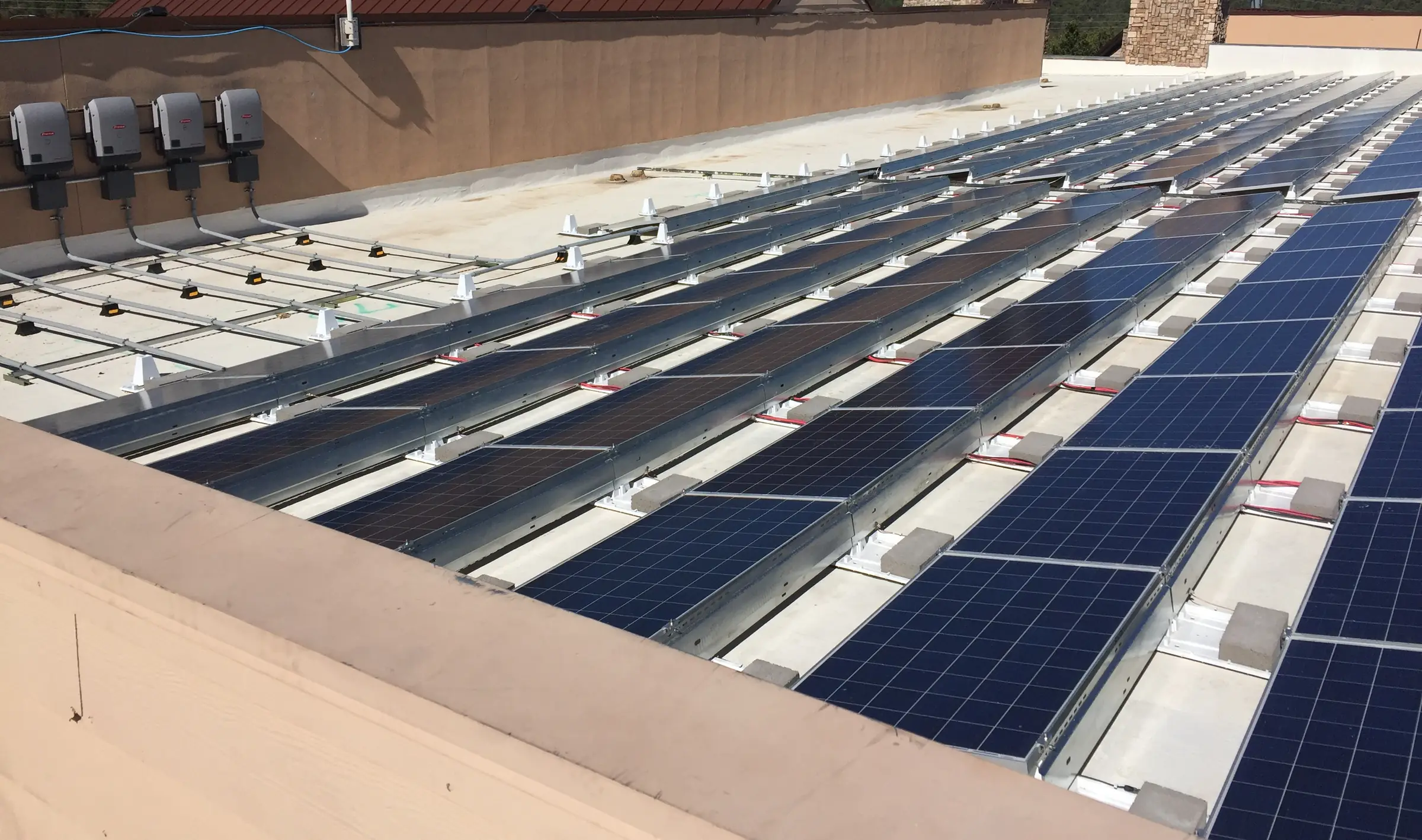
Rio Rancho, New Mexico
Lobo Solar is a solar installer for flat and low-slope roofs in Rio Rancho, NM. It would check parapets, drains and the roof covering, compare ballasted and attached arrays on weight and leak risk, and price solar on its own line, so you know the roof is ready before comparing bids.
Private website concept.
Rio Rancho, New Mexico
Lobo Solar installs on the flat and low-slope roofs that most of Rio Rancho and the West Mesa is built with: parapets, stucco walls, ballasted racks, and the monsoon drains that have to keep working after the panels go on.
What customers say
Serving Rio Rancho and nearby towns
★★★★★5.0 from 16 Google reviews
What we do
Call or visit
| Phone | (505) 225-7007Call to book an assessment. |
|---|---|
| Office | 1746 Gallinas Rd, Rio Rancho, NM 87144Parking on site. |
| Estimates | Free, in writingDesign and price as separate documents. |
Why homeowners pick us
Our story
Installing across Rio Rancho, Bernalillo, Corrales and the West Mesa.
Where we work
Enter the array a bidder proposed. The check adds up the weight it puts on your roof, compares it with the lines in New Mexico's permit rule that call for an engineer, and, if you add the bid figures, divides the solar-only price by the panels' watts. Everything runs on this device; nothing is sent or stored.
Non-solar lines: roof repair or re-coat, the engineer letter, framing reinforcement, a panel upgrade, a battery.
Added dead load
6.9 lb/sq ft
Point load per attachment
None: no roof holes
Engineer review likely
7.04 kW-DC.
Illustrative assumptions: racking about 9.4 lb per panel (ballasted) or rails and hardware about 15.6 lb per panel (attached), and about 22.5 sq ft of roof per panel. The real figures come from the racking maker's layout for your roof. Not checked here: the 200 lb per truss line, unique mounts and over-spanned framing (14.5.2 NMAC).
On a flat roof, the mount method sets the price before panel brand does. A ballasted array sits on racking held down by concrete blocks, so it needs few or no holes in the roof. That weight can push it past the point where New Mexico requires an engineer to check the roof. An attached array is bolted through the roof into the framing. It is much lighter, but every attachment is a hole in the roof membrane that has to be sealed and stay sealed.
Neither is right for every house. Before comparing prices, ask each installer which method they picked and what they checked to pick it.
Three Southwest roof terms come up throughout. A parapet is the low stucco wall that rises above the roof edge on many Rio Rancho homes. A canale is a channel that carries water out through the parapet. A scupper is an opening in the parapet that does the same job.
How we work. Lobo Solar is a solar design-and-install service for flat and low-slope roofs in the Rio Rancho area. Coverage of Rio Rancho and nearby towns covers these towns. Nothing on this page describes an existing business, license, crew or price.
Optional, priced separately: roof repair or re-coat first, an engineer's stamp, a panel upgrade, a battery, and a quote for removing and reinstalling the array at the next re-roof.
The two illustrative examples further down follow one house through documents 2 and 5: the weight budget on the decision sheet, then the solar-only price line.
Two load terms decide this. Dead load is the permanent weight the array adds, spread over its footprint and measured in pounds per square foot (lb/sq ft). Point load is the weight that lands on one spot, such as a single roof attachment.
New Mexico's construction permit rule, 14.5.2 NMAC, requires a structural analysis by a New Mexico-licensed professional engineer (PE) when a roof-mounted array:
Roof-mounted submittals must include the calculated added loads. Framing reinforcement needs a building permit and the engineer's sealed details. A PE letter is the engineer's signed analysis of whether the roof can carry the array.
| Ballasted | Attached | |
|---|---|---|
| How it holds | Weight of concrete blocks on the racking | Fasteners through the membrane into the framing |
| Added dead load | High: the ballast is the anchor | Low |
| Roof holes | Few or none | One per attachment, each sealed into the membrane |
| Roof-warranty question | Does the roof maker allow ballast and pads on this covering? | Does the roof maker allow penetrations, and who must seal them? |
| Engineer trigger | Can cross the 5 lb/sq ft line; check the racking report | Less likely on weight; point and per-truss loads still count |
| Main risk | Weight, and blocks or pads near drains | Leaks at the holes as coats age |
Illustrative example: the weight budget. One 7.04 kW-DC array of sixteen 440 W panels covers about 360 sq ft. Panels at about 45 lb each (720 lb), racking (150 lb) and ballast blocks (1,600 lb) add about 2,470 lb, or 6.9 lb/sq ft. That is over the 5 lb/sq ft line, so a New Mexico engineer must analyze the roof. Attached to the framing, the same panels weigh about 970 lb with rails and hardware, or 2.7 lb/sq ft. Spread across about 40 attachments, each carries roughly 24 lb, under the 45 lb point-load line. The cost is about 40 holes to seal. These weights are illustrative; the real figures come from the racking maker's layout for your roof.
So ask every bidder for the racking report's added dead load in lb/sq ft and the point load per attachment. A ballasted bid that cannot give you a number has not been designed yet.
There is a middle route. One Albuquerque-based racking maker describes optional roof attachments that reduce ballast, on flat-roof products it markets for commercial installations. If a bidder proposes a hybrid, ask which product it is and why it suits a house.
Water leaves a flat roof through a few drains, canales or scuppers. An array placed without a drainage plan can sit in that path. Ask the designer to show on the roof plan:
Next, how will the wiring leave the roof? Conduit, the metal pipe that carries the wires, either crosses the parapet cap or passes through the stucco wall. Someone must seal it, and the plan should say who repairs the stucco.
And does the parapet cap need repair first? In Rio Rancho that changes the paperwork. The city's reroof permit covers stucco work, and the application asks for a copy of the bid proposal. So the roof and stucco bid should be its own document, not a line buried in the solar contract.
Quotes are compared on price per watt ($/W): price divided by size in watts. Use the kW-DC size, the panels' direct-current rating (panel wattage times panel count). The inverter's kW-AC rating matters later, for PNM.
On a flat roof, a whole-bid $/W misleads. These items can show up in a flat-roof bid, and only some of them are solar:
Strip the non-solar lines out, then divide.
| Bid line | Illustrative amount | In solar-only $/W? |
|---|---|---|
| Panels, racking, inverter, wiring, labor, permits | $20,000 | Yes |
| Re-coat membrane and repair parapet cap | $1,900 | No |
| Engineer letter for the ballasted design | $700 | No |
| Total bid | $22,600 |
Illustrative calculation. A 7.04 kW-DC quote for a flat Rio Rancho roof totals $22,600. The whole bid is $3.21/W, which looks 50¢ above the state benchmark. Remove the roof line and the engineer letter: $20,000 ÷ 7,040 W = $2.84/W, 13¢ above the benchmark, or about $920 on this size.
State benchmark: $2.71/W, New Mexico's figure in the EcoGen Solar Cost Index for New Mexico, September 2026 Edition, prices as of September 25, 2026. EcoGen puts a typical 7.04 kW system at $19,078, owned, cash, solar only, before incentives. The index is a modeled installed price before incentives, not a quote, so treat it as a yardstick.
A solar-only price a little above the benchmark can have a reason on a flat roof, such as extra ballast or attachments. A large gap is a reason to ask what the extra pays for. Compare like with like: owned, cash, solar only, no battery, no financing.
Start with the one that is gone. The federal Residential Clean Energy Credit, the 30% credit some local installer pages still mention, is not available for property placed in service after December 31, 2025. For a system you own and switch on in 2026, the federal credit is $0.
New Mexico's New Solar Market Development Tax Credit still applies. Per the EMNRD credit guide, it pays 10% of equipment, materials and labor, up to $6,000 per system. It is refundable and transferable, with a $30 million yearly program cap. EMNRD, the state Energy, Minerals and Natural Resources Department, decides what counts.
Two rules matter for a flat roof:
In the illustrative quote above, 10% of $20,000 is about $2,000, or about $2,070 if EMNRD also accepts the engineer letter. The $1,900 roof line adds nothing. That is the second reason to keep roof work on its own line.
Form RPD-41341 is the state's solar purchase statement: you sign it so the seller can deduct the sale from gross receipts tax. A power-purchase agreement (PPA), where a company owns the panels and sells you the power, gets no state credit. And as summarized by EcoGen, New Mexico law (NMSA 3-18-32) limits covenants that effectively ban solar collectors, so bring your HOA rules rather than assuming a no.
"We handle permits" is not enough. Ask which permits, in what order, and who signs. Rio Rancho's Building Division publishes its forms on the Building Inspection Division forms page. For a flat roof the order would run:
The city's fee lines are dated, so confirm current fees with the Building Division. If your design is ballasted with no reinforcement, also ask whether a building permit is needed alongside the electrical permit; the published forms do not say.
Rio Rancho's inspectors also work beyond the city line. They perform the electrical inspections for Corrales, where the village issues the building permit.
PNM, the Public Service Company of New Mexico, is the utility the state's Public Regulation Commission lists for Rio Rancho. Cooperatives serve parts of Sandoval County, so check the name on your bill before you size anything; the utility check for Bernalillo addresses shows why.
PNM's solar pages described the PNM steps below in archived copies from July and October 2026. Confirm them on pnm.com before you sign.
The state interconnection rule, 17.9.568 NMAC, sets a $150 application fee for systems up to 25 kW. Permission to operate (PTO), the utility's go-ahead to switch on, normally follows within 10 business days after the utility has the completed application, the signed agreement and the final electrical inspection clearance.
According to PNM's net-metering terms as archived in October 2026, a Small PV system, with an inverter rated 10 kW-AC or less, banks surplus energy as kWh credits that never expire; remaining credits are paid out when the account closes. Above 10 kW-AC, surplus is paid monthly at PNM's Rate 12. So ask every bidder for the inverter's AC rating, not only the panels' DC size. A bid near 10 kW can land on either side of the line depending on the inverter.
The sequence, with no promised dates:
Steps 3 and 4 come before the permits for a reason: the roof bid goes into the reroof application, and the engineer's figures go into the solar submittal. If a bidder cannot say who files step 10, the credit is at risk.
A roof coat may need renewing while the panels are still on it. PNM's archived "Is Your Roof Ready for Solar?" guidance tells customers to ask the solar company what happens if the roof needs repair after installation, and to include the cost of removing and reinstalling the panels in their numbers. PNM puts a typical roof's life at about 20 years and suggests an inspection if you do not know its age.
Settle these before you sign:
If the roof is near the end of its life, re-roofing first may cost less than taking the array down later, as the U.S. Department of Energy argues in an article on replacing a roof and adding solar together (national figures, 2021).
Use these with the quote checklist on this site.
Red flags:
Is solar worth it in New Mexico? It depends on your roof, your PNM usage and your price, so check the method, not a promise. EcoGen's state model assumes about 1,824 kWh a year per kW in the Albuquerque area (a state figure that does not model a flat-roof tilt). Compare solar-only $/W with the state benchmark, check the inverter against PNM's 10 kW-AC line, and count only credits that still exist.
Does a ballasted array mean no holes? Usually few or none, but the weight may trigger an engineer review. Ask for the hole count either way.
What is the biggest downside of solar on a flat roof? The array sits on a covering you will have to renew. When the roof needs a new coat, the array may have to come off and go back on. Price that before you sign.
Can I still claim the 30% federal credit? Not for a system you own placed in service after December 31, 2025. A quote that still counts it is out of date.
Each town guide follows the office that signs off the work. Miles are straight lines from the Rio Rancho listing address, not road miles or a service limit. Coverage of these towns is proposed and unconfirmed.
Pick your town, what is on your roof and the mount you are leaning toward. The site builds the checklist to bring to any installer's quote visit, so each bid answers the same roof questions. It runs on this device: nothing is sent or stored.